
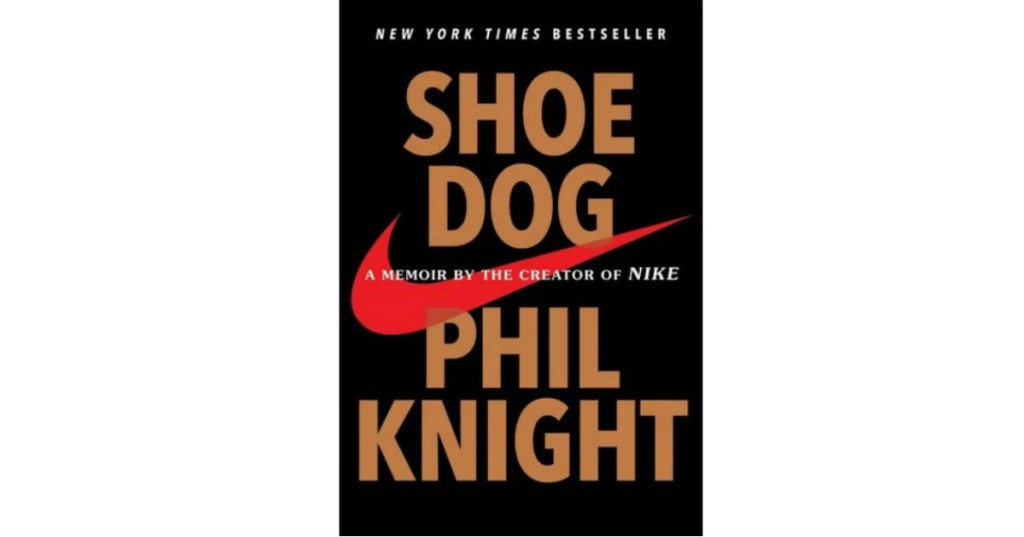
I have always been a huge Nike fan. I do not recall ever seeing any Nike advertisements growing up, yet somehow, Nike was a household name back in Nigeria, where owning one was a sign of wealth and privilege. It is understandable why I immediately jumped at the book “Shoe Dog” when I saw it on the list of books to read. Phil Knight’s remarkable storytelling taught me a lot about writing, business, and leadership, and I could easily relate some of the leadership concepts I learned in class to him.
The term “shoe dog” refers to someone who devotes their time and being to producing, selling, buying, or designing shoes (Phil Knight, 2016), and that is the depiction of Phil Knight, a University of Oregon runner and Stanford graduate. The book describes Phil Knight’s journey as he builds Nike, one of the world’s most popular shoe businesses.
The “crazy idea” was born in 1962, when Phil moved back home to live with his parents. With a loan from his dad and no business name, he embarked on a trip to woo the Japanese into doing business with him. With a breakthrough from the Japanese, he also wooed his renowned coach, Bill Bowerman, into becoming his partner in 1964. The idea was to compete with the saturated German market by importing athletic shoes from Japan, and thanks to his persistence and Bowerman’s expertise and flair for athletic shoes, he opened his first retail outlet in 1965. In 1972, after a long battle with the Japanese, the company expanded to other regions and the name was changed from Blue Ribbon to Nike.
Phil Knight possessed a distinct leadership style that fostered innovation, passion, and a sense of belonging. He was able to persuade his partners and followers to do what he wanted without doing much. Some may regard him as a transformational leader, while others may regard him as a laissez-faire leader. In the book, he describes himself as a laissez-faire leader. This paper will delve deeper into his leadership approach.
Luck or leadership?
When reading this book, I had several thoughts in my head, one of which was, “Was Phil Knight just lucky to have met like-minded people who recognized his vision and remained with him through the difficult times, or was he just an exceptional leader?” Phil Knight himself highlighted the topic of luck towards the end of the book when he said, “Luck plays a big role. Yes, I’d like to publicly acknowledge the power of luck. Athletes get lucky, poets get lucky, and businesses get lucky. Hard work is critical, a good team is essential, brains and determination are invaluable, but luck may decide the outcome.” I believe that while Phil Knight was lucky to have the best idea at the perfect time and to have great friends, family, and partners who helped him realize his vision, his success also stems from his exceptional leadership abilities.
Although Phil Knight perceived himself as a laissez-faire leader, I also noticed some transformational leadership qualities in him that will be covered in a later part of this paper. Laissez-faire is frequently referred to as “non-leadership” because it provides followers with a great deal of freedom to act as they please. Laissez-faire leaders frequently avoid interacting with their followers and provide no instruction or assistance. In the early stages of the company, Phil’s relationship with Johnson portrayed this. Phil frequently ignored his letters and allowed him carte blanche to act however he wished. While this approach might not be successful for other businesses, it worked for the Nike team. Phil gave his employees at Nike enough latitude to be innovative and produce results in their own way. When describing his relationship with his first employee, Jeff Johnson, Phil said, “He’d complained a million times about my lack of communication, but in fact, my laissez-faire management style had fostered him, unleashed him… He saw that my managerial style gave him freedom. Left to do as he pleased, he responded with boundless creativity and energy.”
Using the Blake and Mouton Managerial Grid and the persona I created from the book, Phil Knight scored strongly in both people and tasks, designating him as a team leader. Team leaders always work to bring their members closer together while also motivating them to achieve their objectives. Phil’s informal manner helped him as a team leader, even though he was not really recognized as a leader who offered words of support or had the charisma to inspire his workers. When necessary, he inspired his workers, and he always encouraged a sense of camaraderie. Below is an example of him motivating his team members.
“This is the moment we’ve been waiting for. Our moment. No more selling someone else’s brand. No more working for someone else. Onitsuka has been holding us down for years… We posted two million in sales last year, none of which had anything to do with Onitsuka. That number was a testament to our ingenuity and hard work. Let’s not look at this as a crisis. Let’s look at this as our liberation. Our Independence Day. Yes, it’s going to be rough. I won’t lie to you. We’re definitely going to war, people. But we know the terrain. We know our way around Japan now. And that’s one reason I feel in my heart that this is a war we can win. And if we win it—when we win it—I see great things for us on the other side of victory. We are still alive, people. We are still. Alive.”
Leadership styles and traits displayed
Gary Yukl (2013, as cited in Rowe & Guerrero, 2016) defined leadership as “the process of influencing others to understand and agree about what needs to be done and how to do it, as well as the process of assisting individual and collective efforts to attain agreed objectives.” Without a doubt, Phil Knight was a leader who demonstrated a number of leadership traits that have been categorized into various themes below.
Phil Knight as a Transformational Leader
Transformational leaders are individuals who inspire and drive their followers to achieve extraordinary results and grow as leaders themselves (Hackman & Johnson, 2009). This style of leadership creates followers that excel in their work and are committed to attaining the organization’s objectives. Despite using a “do as you please” leadership style, Phil Knight was able to inspire confidence in and loyalty from his partners and employees. There were several occasions when he was going to lose his business, but his followers stuck by him, and in some cases, they even increased as he went through difficult times. For instance, his first counsel, Strasser, joined his cause during his conflict with the Japanese shoemaker Onitsuka, and the Japanese trade firm Nissho saved him when the Bank of California cut him off and it appeared that Blue Ribbon would not survive. The characteristics of transformational leadership as defined by Hackman and Johnson (2009) will be used to further assess Phil Knight’s transformational leadership traits.
- Creativity: Hackman and Johnson (2009) state that “transformational leaders are creative and forward-thinking. They continually question the status quo by looking for fresh concepts, solutions, and methods.” This was what Phil Knight was all about. Phil’s “rebellious spirit” and his desire for something new and creative served as the foundation for the entire Nike concept. In his book, he made the following statement on creative leadership: “We were trying to create a brand but also a culture. We were fighting against conformity, against boringness, against drudgery. More than a product, we were trying to sell an idea, a spirit.” He undoubtedly repeatedly displayed this transformative quality.
Sternberg et al. (2004, as cited in Puccio, Murdock & Mance, 2007) defined creative leadership as the process of pushing “others to move beyond where they are to where the leader wishes them to go” in their study relating creativity and leadership. Several times, according to Phil Knight, he had to relocate Johnson and Woodell in order to either build an entirely new retail store or make improvements to an already existing one. They found this to be exceedingly uncomfortable, but their loyalty to the organization and their leader forced them to make those compromises. - Interactive: Transformational leaders are great communicators who can clearly articulate their thoughts and introduce others to new ideas. Phil Knight described himself as introverted and frequently shied away from conflict. In fact, he frequently sent Johnson or Woodell to employees to negotiate with them when he needed to. Nevertheless, he still possessed excellent communication abilities that allowed him to persuade Onitsuka to sign a contract in the first place; make one of the most renowned coaches his partner, persuade Johnson to quit his job as a social worker in order to support his cause, and persuade Nissho to provide funding for his venture.
- Visionary: Phil Knight may have frequently lived in the moment, especially when he defied bankers’ advice to save some money for the company rather than spend it all on more products, but he had a clear vision for the business which was to outperform the then-dominant Adidas and offer athletes better solutions. He not only had this vision, but he was also able to convey it to his followers and convince them to fully support his cause.
- Empowering: “Transformational leaders know how to give power away,” according to Hacking & Johnson (2009). They encourage their followers to participate fully in the organization’s decision-making process and do not feel intimidated by their followers’ efforts. This, in my opinion, is the pinnacle of Phil Knight’s leadership approach. He told his employees that he needed a name for his company when he was at war with Onitsuka over Blue Ribbon, and they all sat down to brainstorm. Johnson eventually came up with the name for the company, and without giving it much thought, and with approval from the other team members, he introduced Nike to his new partners. There were several instances when he delegated decision-making to his followers. This was particularly clear at their “Buttface” board meeting and retreat when his team gathered to address problems facing the business while being free to joke around and be as casual as possible. He asserted that the majority of brilliant concepts and solutions were gotten from their jokes.
- Passionate: Phil Knight’s enthusiasm for his business was incredibly contagious. It was his passion that drew him to his wife Penny and kept others, particularly athletes like Pre, loyal to him until the very end. He had a strong sense of loyalty to his coworkers and a strong commitment to his career, even when it threatened to negatively impact his family. He constantly left a bit of himself behind when he met new people, and the individuals he met also developed a love for shoes.
The Birth of CSR in Nike
Nike has a reputation for corporate social responsibility, and in the past, this has also brought up negative news for the company (DeTienne & Lewis, 2005). The company’s social culture was established when Pre passed away in 1975, as I learned from reading the book. “Someone needed to curate Pre’s rock, and I decided that someone needed to be us. We didn’t have money for anything like that. But I talked it over with Johnson and Woodell, and we agreed that, as long as we were in business, we’d find the money for things like that,” Phil said.
Personal Take and Key Points
I found a lot of inspiration in the book since, like Phil, I decided to leave my job in Nigeria and pursue a different path on another continent. In addition to his leadership abilities, I think Phil was successful because he had devoted followers who viewed his company as their own and remained committed. Using the Followership Style Questionnaire by Robert Kelley (Hackman & Johnson, 2009), I will classify Phil’s followers as exemplary followers who were highly independent thinkers and active engagers. Not many leaders are gifted with devoted followers like Phil’s. They consistently offered creative solutions and went above and beyond what was expected of them.
Conclusion
The goal of the book “Shoe Dog” was to both recount the personal narrative of Nike’s co-founder, Phil Knight, and provide advice for other business owners. With Phil’s account of his journey, which spanned from the time he had the business idea through his retirement, we were able to examine his leadership qualities. Phil ranks highly as a laissez-faire boss who gave his workers the freedom to do as they pleased, included them in the decision-making process, and gave them the resources they required to be leaders themselves. He demonstrated a lot of transformational leadership qualities as well, making him both a laissez-faire and transformational leader. Using excerpts from the book as a reference, this essay has provided insight into his life story and leadership style.
References
Knight, P. (2016). Shoe dog: A memoir by the creator of Nike. Scribner, New York.
Hackman, M. Z., & Johnson, C. E. (2009). Transformational and charismatic leadership In Leadership: A communicative perspective (pp. 101–129). Waveland Press, INC.
Hackman, M. Z., & Johnson, C. E. (2009). Leadership and followership communication styles. In Leadership: A communicative perspective. Waveland Press, Inc.
Puccio, G. J., Murdock, M. C., & Mance, M. (2007). Change leadership and creativity. In Creative leadership: Skills that drive change (pp. 3–26). SAGE Publications.
Rowe, W. G., & Guerrero, L. (2016). Leadership: What is it? In Cases in Leadership (pp. 1–3). SAGE Publications.DeTienne, K. B., & Lewis, L. W. (2005). The pragmatic and ethical barriers to corporate social responsibility disclosure: The Nike case. Journal of Business Ethics, 60, 359–376
 Tabitha Oyewole
Leave a comment